.png)
Buddhism and Mindfulness: Where the Practice Really Comes From
- Coralie Bengoechea

- Dec 31, 2025
- 4 min read
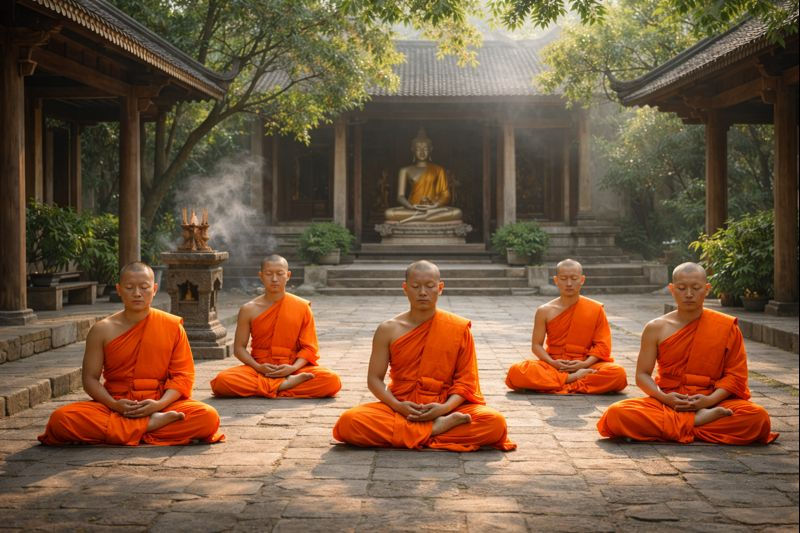
Mindfulness is widely practiced today for stress relief, mental clarity, and emotional balance, but its deeper meaning is often misunderstood. Long before mindfulness became a modern wellness technique, it was developed within Buddhism as part of a structured path to understand the mind and reduce suffering. Exploring the Buddhist roots of mindfulness helps clarify what the practice was originally meant to cultivate, and why its impact goes far beyond relaxation or productivity.
Written by Coralie Bengoechea | 31 December 2025
Mindfulness didn’t start as a productivity tool, a wellness trend, or a stress-management technique.
It began as part of a much larger system of understanding the human mind - one rooted in Buddhism, developed over thousands of years as a way to reduce suffering and see reality more clearly.
Today, mindfulness is often separated from its origins. That can make it more approachable, but it can also strip away the depth that gives the practice its real power. Understanding where mindfulness comes from doesn’t require becoming Buddhist - but it does change how the practice is understood and used.
Mindfulness Was Never Meant to Be a Quick Fix

In Buddhism, mindfulness is known as sati, which means "remembering or bearing something in mind."
It refers to the capacity to stay aware of what is happening:
In the body
In the mind
In emotions
In the present moment
This awareness wasn’t taught as a way to feel calm all the time. It was taught as a way to see clearly, especially when things are uncomfortable.
From a Buddhist perspective, mindfulness helps you notice:
How craving arises
How aversion takes hold
How thoughts create stories
How suffering is built moment by moment
Calm can arise from this clarity, but calm is not the goal.
The Buddha’s Insight Was Psychological, Not Mystical

At its core, Buddhism is less about belief and more about observation.
The Buddha didn’t ask people to accept ideas on faith. He encouraged them to look directly at their own experience:
What happens when you cling?
What happens when you resist?
What happens when you stop reacting automatically?
Mindfulness was the tool used to investigate these questions.
In this way, Buddhist mindfulness functions much like a psychological practice:
Observing patterns
Recognising conditioning
Interrupting habitual reactions
Creating space between stimulus and response
This is why mindfulness translates so well into modern psychology and therapy.
Mindfulness Is Only One Part of the Buddhist Path

In Buddhism, mindfulness doesn’t stand alone.
It exists alongside:
Ethical awareness (how actions affect suffering)
Concentration (the ability to stabilise attention)
Wisdom (seeing impermanence, non-attachment, and interdependence)
When mindfulness is removed from this wider context, it can become shallow — used only to tolerate unhealthy situations rather than understand or change them.
Originally, mindfulness supported insight: Not “How can I cope better?” but “Why am I suffering in the first place?”
Why Mindfulness Can Feel Challenging at First

Buddhist teachings are very clear about this: When you pay attention, you don’t immediately feel better — you see more.
This includes:
Restlessness
Fear
Desire
Sadness
Mental noise
Mindfulness reveals what has been there all along.
In Buddhist practice, this discomfort is not treated as a problem. It’s treated as information. Awareness comes before ease.
That is why mindfulness was never framed as self-improvement. It was framed as self-understanding.
Modern Mindfulness vs Buddhist Mindfulness

Modern mindfulness often focuses on:
Stress reduction
Focus
Emotional regulation
Performance
Buddhist mindfulness focuses on:
Understanding suffering
Seeing impermanence
Letting go of attachment
Cultivating compassion and clarity
Neither approach is wrong — but they serve different purposes.
When mindfulness is practiced without its deeper roots, it can help you function better. When practiced with understanding, it can change how you relate to everything.
You Don’t Need to Be Buddhist to Practice Mindfulness

Mindfulness is a human capacity, not a religious identity.
You don’t need to adopt beliefs, rituals, or labels to practice it meaningfully. But knowing its origins helps set realistic expectations.
Mindfulness is not about:
Emptying the mind
Escaping difficulty
Becoming calm on demand
It’s about learning to be present with experience — especially when it’s uncomfortable — and discovering that awareness itself is stabilising.
The Quiet Thread That Connects It All

At its heart, Buddhism teaches that suffering less doesn’t come from controlling life, but from understanding it.
Mindfulness is the doorway into that understanding.
Not dramatic. Not instant. But quietly transformative.
And that’s why, thousands of years later, it’s still being practiced — even when the language around it has changed.
Want to explore further?
Relax with our guided meditations on our Akashic Tree YouTube channel: https://www.youtube.com/@AkashicTree
Read our other articles about health, wellness and psychology: https://www.akashictree.com/blog
Join one of our meditation courses or a retreat: https://www.akashictree.com/all-events
Book a private healing session with us: https://www.akashictree.com/services
Get in touch with us at info@akashictree.com


Comments